
What Is a Travel Massage Gun and How Does It Work?
A Travel Massage Gun is a compact percussion device designed to deliver quick, repeated taps into muscle tissue. Its motor moves a small attachment backward and forward, creating pressure and vibration against targeted areas. Different heads and speed settings change the sensation, while battery power supports use in hotel rooms, airports, or after long walks. It is not magic. It is a portable recovery tool.
Industry reports show why this category continues attracting attention. Grand View Research’s 2024 massage equipment analysis identifies rising interest in home wellness and compact recovery products. Fortune Business Insights also reports continued growth in the global massage equipment market, linked partly to consumer demand for convenient self-care. These reports often group several product types together, so their figures should not be treated as exact sales data for travel massage guns alone.
In practical use, percussion may temporarily increase local blood flow and reduce the feeling of muscle tightness. The effect depends on pressure, speed, body area, and individual tolerance. A traveler might use a lower setting on calves after walking through a large airport, rather than pressing hard into one spot. Avoid bones, the front of the neck, open wounds, and areas with reduced sensation. People with medical conditions should ask a qualified healthcare professional before use.
The technology is simple.
The judgment is harder.
A Travel Massage Gun should complement sleep, hydration, stretching, and sensible training, not replace them. This article explains its internal mechanism, realistic benefits, travel-friendly features, and limitations, while questioning marketing claims that sound stronger than the available evidence.
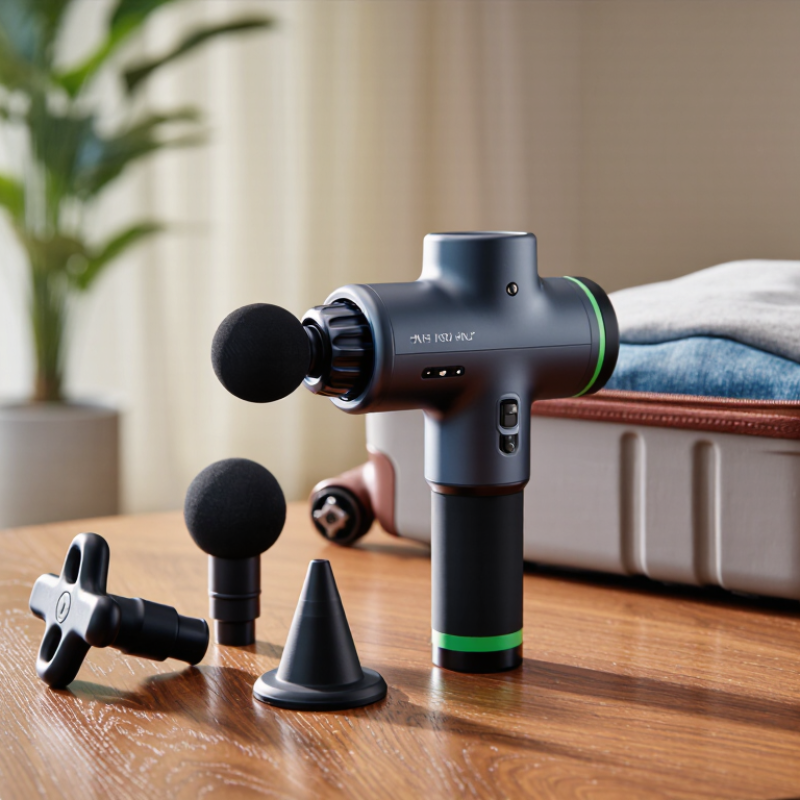
Travel Massage Guns: Definition, Components, and Portable Design
What Is a Travel Massage Gun and How Does It Work?
Travel massage guns are compact percussive therapy devices designed for use away from home. They deliver repeated, controlled pulses through a soft attachment. These pulses may temporarily ease muscle tightness and improve comfort after exercise or long travel.
A typical unit contains a rechargeable battery, a small motor, an eccentric drive, speed controls, and interchangeable heads. The motor moves the attachment rapidly back and forth. Round heads suit larger muscle areas, while smaller heads provide more focused contact. However, attachment shapes do not create completely different treatments. Pressure, speed, and personal tolerance matter more than marketing claims.
Portable design changes the whole experience. A travel model usually has a shorter handle, lighter housing, protective storage, and a charging port suitable for common travel setups. Some include a travel lock to prevent accidental activation inside luggage.
Lower weight helps with packing, but it may also mean a smaller battery or less powerful motor. That trade-off is easy to overlook. Convenient, but not perfect.
Use the device on fleshy muscle areas, not bones, joints, the front of the neck, or damaged skin. Start with low intensity and brief sessions. Stop if sharp pain, numbness, unusual swelling, or bruising appears. People with circulation problems, recent injuries, or implanted medical devices should ask a qualified clinician before use. A massage gun can support recovery habits, but it cannot diagnose or treat an underlying condition.
How Percussion Works: RPM, Amplitude, Force, and Tissue Response
A travel massage gun is a compact percussion device designed for recovery away from home. It uses a small motor to move a soft attachment rapidly against the body. This repeated tapping can increase local sensation and may temporarily ease muscle tightness.
RPM means repetitions per minute. Higher RPM feels quicker, but it does not automatically create better results.
Amplitude describes how far the attachment travels, often measured in millimeters. Greater amplitude may reach deeper muscle layers, while shorter movement can feel gentler.
Force depends on how firmly you press and how well the motor resists that pressure. More force is not always useful. Tissue can become irritated when pressure stays intense for too long.
I once assumed the strongest setting would work fastest. That assumption was too simple. After using percussion on tired legs, moderate speed and light pressure felt more comfortable than maximum power. Relaxed muscle usually responds better than guarded muscle. Start with low RPM and keep the device moving slowly over the muscle. Limit each area to a short session. Avoid bones, joints, the front of the neck, open wounds, and areas with reduced sensation. Stop if you feel sharp pain, numbness, unusual swelling, or lingering soreness. A massage gun is not a diagnosis or a substitute for clinical care. People with circulation problems, recent injuries, or unexplained pain should ask a qualified health professional before using percussion.
Industry Specifications: 1,800–3,200 RPM, 12–16 mm, and Battery Ratings
A travel massage gun is a compact percussion device designed for use away from home. Its motor drives a soft attachment rapidly against the muscles. This repeated pressure may help users feel less stiff after flights, long drives, or training sessions. The device is not a medical diagnostic tool. Technique and comfort matter.
Industry specifications commonly list 1,800–3,200 RPM, meaning the attachment moves through repeated cycles each minute. Lower speeds feel gentler around tight calves or shoulders. Higher speeds can feel sharper, but faster is not automatically better. A 12–16 mm stroke length describes how far the attachment travels inward and outward. A 12 mm stroke usually feels moderate. A 16 mm stroke reaches deeper tissue and requires lighter hand pressure. Do not press hard over bones, joints, or irritated skin.
Battery ratings need careful reading. A compact unit may list 1,500–2,500 mAh, but capacity alone does not predict operating time. Motor power, speed selection, and load change actual performance. Runtime measured at low speed may look impressive. It can drop noticeably at 3,200 RPM. Check the stated voltage, charging method, and tested runtime when comparing specifications. In practical use, a travel model should survive several short sessions without becoming heavy in a carry-on. I would still question vague battery claims. Numbers without testing conditions are incomplete. A warm handle, sudden speed loss, or unusual noise suggests stopping the session and inspecting the device.
Clinical Evidence: Acute Mobility Gains and Limits of Recovery Claims
What Is a Travel Massage Gun and How Does It Work?
A travel massage gun is a compact device that delivers repeated pulses to soft tissue. Its motor moves a rounded attachment rapidly against the skin and underlying muscle. This stimulation may increase local sensation and temporarily reduce feelings of stiffness. After a long flight, gentle use on the calves can make the first walk feel easier.
Clinical evidence supports modest, short-term mobility gains. Studies on percussive therapy often report improved range of motion without reducing immediate muscle strength. These changes may come from altered pain sensitivity, increased tolerance to stretching, or temporary changes in muscle tone. The effect is brief. It should not be confused with stronger tissue, faster healing, or improved athletic performance.
Recovery claims need more caution. Current research does not clearly show that a massage gun removes muscle damage, prevents delayed soreness, or speeds injury repair. I would use low pressure and slow passes before activity, then reassess how the body responds. Avoid painful areas, bones, open wounds, and suspected injuries. People with circulation problems, recent surgery, unexplained swelling, or significant pain should seek clinical advice first. A common mistake is pressing harder when relief does not appear. More pressure is not automatically more effective.
What Is a Travel Massage Gun and How Does It Work?
Clinical Evidence: Acute Mobility Gains and Limits of Recovery Claims
A travel massage gun delivers rapid percussive pulses to soft tissue. Controlled studies suggest that a short application can produce an immediate increase in range of motion, while evidence for improving strength, reducing delayed soreness, or accelerating recovery remains limited or inconsistent.
How to read the chart: The score is qualitative rather than an effect size: 1 indicates a consistently reported acute mobility benefit, while 0 indicates that a clear benefit has not been established. The strongest evidence concerns short-term range-of-motion changes; this should not be interpreted as proof of faster tissue healing or long-term recovery.
Evidence basis: controlled studies of percussive therapy, including Konrad et al., Journal of Sports Science & Medicine (2020), and subsequent clinical studies reviewing acute mobility and performance outcomes.
Safe Use and Travel Compliance: Contraindications and TSA’s 100-Wh Rule
A travel massage gun is a compact device that delivers rapid, repeated pulses into muscle tissue. Its motor moves the massage head back and forth, creating pressure that may ease temporary stiffness after walking, flights, or exercise. In practice, the easiest mistake is pressing too hard. Use a low setting first, keep the head moving, and target large muscles such as the calves, thighs, and shoulders. Avoid the front of the neck, spine, joints, bones, and areas with reduced sensation.
Safety matters more than portability. Do not use a massage gun over open wounds, bruises, acute injuries, suspected blood clots, fractures, or severe swelling. People with bleeding disorders, circulation problems, implanted medical devices, or pregnancy should ask a qualified clinician before use. Stop immediately if you feel sharp pain, numbness, dizziness, or unusual weakness. It is not a substitute for medical care.
For air travel in the United States, check the battery’s watt-hour rating before packing. A lithium-ion battery under 100 Wh is generally accepted, but spare batteries must travel in carry-on baggage. Batteries from 101 to 160 Wh usually require airline approval, while larger batteries are generally not allowed for passenger travel. A device with an installed battery should be completely switched off and protected from accidental activation. Carry-on storage is usually the safer choice. Rules can change, and airline policies may be stricter. The label is sometimes unclear, so verify it before leaving home.
| Data Dimension | Key Fact or Measurement | Practical Meaning | Safe Travel Guidance |
|---|---|---|---|
| Definition | A travel massage gun is a compact, battery-powered percussive therapy device designed to deliver repeated mechanical pulses to soft tissue. | It is generally used for temporary muscle relaxation, warm-up support, and post-activity comfort rather than for diagnosing or treating a medical condition. | Choose a lightweight model with a protective case, secure controls, and a removable or clearly rated rechargeable battery when possible. |
| How it works | An electric motor moves an internal shaft back and forth, driving a soft attachment into the body at a selected speed and force. | The repeated motion can temporarily increase local stimulation and may reduce the sensation of muscle tightness. | Use slow, controlled passes on large muscle groups. Do not press aggressively or keep the device stationary on one spot for an extended period. |
| Common operating controls | Typical controls include a power button, several speed levels, and sometimes a pressure or battery indicator. | Lower settings are easier to control and are usually appropriate when starting a session or using the device near sensitive areas. | Turn the device off before placing it in a bag. Prevent accidental activation by using a travel lock, case, or separate protective pouch. |
| Typical session duration | A practical starting point is about 30 seconds to 2 minutes per muscle area, with a short overall session. | Longer or harder use does not necessarily provide greater benefit and can cause soreness, bruising, skin irritation, or numbness. | Stop if sharp pain, tingling, unusual weakness, dizziness, significant swelling, or skin discoloration occurs. |
| Suitable body areas | Large, fleshy muscles such as the quadriceps, hamstrings, calves, glutes, and upper back are generally more suitable targets. | Soft muscle tissue provides more cushioning and control than bony or highly sensitive areas. | Keep the device away from the front and sides of the neck, head, spine, joints, kidneys, throat, and areas with open skin or active inflammation. |
| Areas to avoid | Avoid direct use over bones, the spine, the front of the neck, the head, major blood vessels, varicose veins, wounds, rashes, and recently injured tissue. | Direct percussion in these locations may increase pain or tissue injury and is not a substitute for clinical assessment. | Use only around, not directly over, a painful or injured area unless a qualified healthcare professional has advised otherwise. |
| Major contraindications | Do not use without medical clearance if you have a suspected fracture, acute muscle tear, severe sprain, unexplained severe pain, active bleeding, or a recent operation. | Percussion may aggravate damaged tissue or interfere with recovery. | Seek medical advice before travel if symptoms are new, severe, worsening, or associated with loss of function. |
| Blood-clot and bleeding risk | Do not use over a suspected or confirmed deep-vein thrombosis, blood clot, or an area with significant swelling, warmth, and redness. | Mechanical stimulation could be unsafe when a clot or abnormal bleeding risk is present. | People taking anticoagulants, living with a bleeding disorder, or who bruise easily should obtain individual medical advice before use. |
| Pregnancy and medical conditions | People who are pregnant or who have conditions affecting circulation, sensation, bones, nerves, or healing should consult a healthcare professional first. | Reduced sensation may make it difficult to detect excessive pressure or tissue damage. | Do not use on the abdomen during pregnancy unless specifically directed by a qualified clinician. |
| Battery rating formula | Watt-hours (Wh) = battery voltage (V) × ampere-hours (Ah). If the label lists milliamp-hours, divide mAh by 1,000 before calculating. | Example: a 14.8 V battery rated at 2.0 Ah equals 29.6 Wh. | Check the battery label, user manual, or manufacturer documentation before flying. Do not estimate the rating from physical size alone. |
| TSA and U.S. aviation battery threshold | Spare lithium-ion batteries rated at 100 Wh or less are generally permitted in carry-on baggage without airline approval under standard U.S. aviation rules. | The 100-Wh limit applies to the battery’s energy rating, not to the massage gun’s motor power or charging speed. | Keep spare or removable lithium batteries in carry-on baggage and protect terminals from short circuits. |
| Batteries above 100 Wh | Spare lithium-ion batteries above 100 Wh and up to 160 Wh may require airline approval and are generally limited in quantity; batteries above 160 Wh are not permitted for passenger air transport. | Airline rules can be more restrictive than the baseline aviation standard. | Contact the operating airline before departure if the battery exceeds 100 Wh. Do not rely on airport screening staff to approve an undocumented battery. |
| Installed battery versus spare battery | A battery installed inside a device is treated differently from a spare battery, but carry-on transport is the preferred option for portable electronic devices. | Carry-on baggage allows the device to be monitored and reduces the risk associated with damage or overheating in the aircraft hold. | Carry the massage gun in hand luggage whenever practical. If an airline permits checked transport, switch the device completely off and protect it from accidental activation or damage. |
| Airport security screening | Security officers have final authority to decide whether an item may pass through a checkpoint. | A device that meets a battery rule may still require additional inspection. | Remove the massage gun from its case if requested, keep battery specifications accessible, and check the current rules for the departure and transit airports. |
| Charging safety | Use the supplied or manufacturer-approved charger and inspect the battery, cable, and housing for damage before charging. | Damaged, swollen, unusually hot, leaking, or smoking lithium batteries can present a fire hazard. | Do not charge a damaged battery or leave the device charging unattended. Unplug it when fully charged and keep it away from heat and moisture. |
| International travel | Battery and security requirements may vary by country, airline, airport, and aircraft type. | Meeting a U.S. TSA guideline does not automatically guarantee acceptance on an international itinerary. | Confirm the rules with every operating airline, especially for codeshare flights, connections, and destinations with separate aviation regulations. |
| Recommended travel checklist | Confirm the Wh rating, pack the device securely, protect battery terminals, carry documentation, and verify airline requirements. | Preparation reduces delays at screening and helps prevent battery damage. | Keep the massage gun accessible in carry-on baggage, fully powered off, and separated from liquids or objects that could press its controls. |
Article Source:
Submit a quote request or book a design consultation
Plastimold Products is an end-to-end product development and manufacturing team. We provide product design, engineering, prototyping, tooling, plastic injection molding, assembly, packaging and fulfillment. We work with any size company from start-ups to enterprises from all around the world.
I have a product I want to manufacture
I have a product that is already designed and now needs to be manufactured.
I need a manufacturer to optimize my product for injection molding, help choose the correct material, and manage the product production.
I have tooling that I want to transfer or modify, or I need to produce new tooling.
I need design and engineering support
I have a product concept that I want to be designed and brought to market.
I have a product that needs to be reviewed, improved or DFM’ed.
I am looking for a manufacturer to provide an end-to-end solution, from design and development to inventory, marketing, and sales.

©2022 Plastimold Products - Privacy policy - Terms and Conditions

