
What Are the Top Solar Light Pole Types in 2026?
Choosing the right solar light pole in 2026 requires more than comparing panel size or advertised brightness. It requires evidence.
The International Renewable Energy Agency reported that global solar capacity reached about 1,419 gigawatts by the end of 2023. The International Energy Agency also expects solar photovoltaic power to lead renewable capacity growth through 2030. These figures matter because larger solar deployment is improving batteries, controllers, LEDs, and remote-monitoring systems. However, a solar light pole still performs locally. A shaded roadside, dusty panel, weak battery, or poorly calculated winter load can reduce lighting quality overnight.
The perfect pole does not exist.
Thomas Edison once said, “I’d put my money on the sun and solar energy.” His statement was not about modern street infrastructure, but it captures the technology’s long-term direction. Today’s designers must apply that optimism more carefully. They must examine pole height, wind exposure, battery chemistry, solar-panel angle, lighting uniformity, and maintenance access. Industry reports often describe strong market growth, yet market forecasts can differ because manufacturers define “solar street lighting” differently. That deserves reflection.
This guide compares the top solar light pole types expected to shape 2026 projects. It considers all-in-one, split-type, smart, hybrid, and high-mast designs. Each option has a different footprint, service routine, and risk profile. A coastal highway needs a different solution from a residential footpath. The best choice is not always the brightest. It is the system that delivers dependable light, measurable efficiency, and practical maintenance over many seasons.
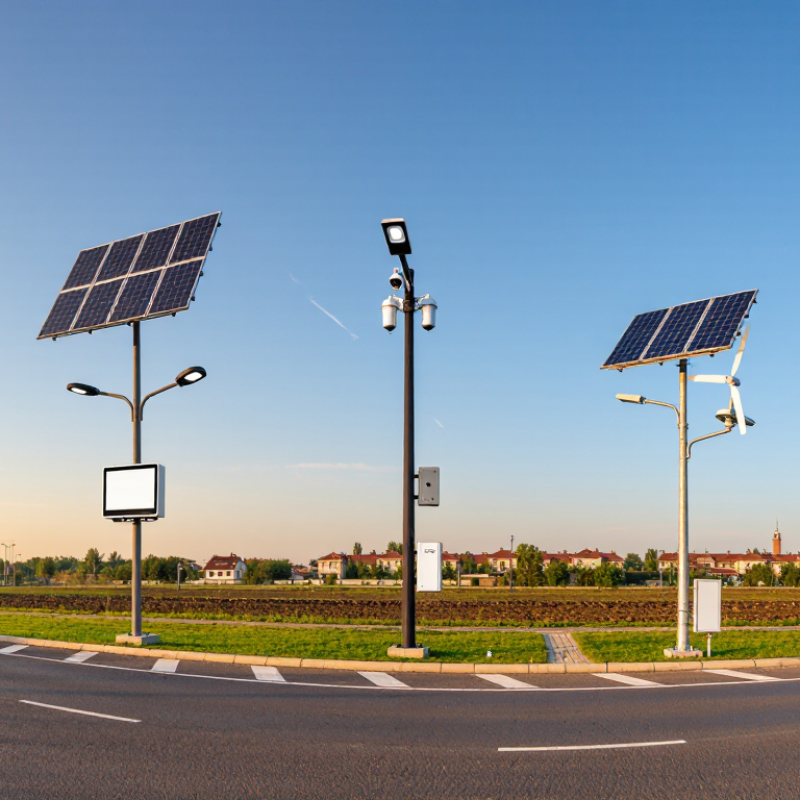
What Are Solar Light Poles and How Do They Work?
Solar light poles are outdoor lighting systems that generate and store their own electricity. A photovoltaic panel captures sunlight during the day. A charge controller regulates that energy. The battery stores it for nighttime operation. At dusk, a light sensor activates the LED fixture automatically. The controller then manages brightness, battery protection, and operating time.
Common designs include all-in-one, split, and hybrid solar poles. All-in-one models place the panel, battery, and LED module together. Split systems separate the panel from the light head, which improves panel positioning in shaded locations. Hybrid systems may connect solar power with another electricity source. This can support areas with long winter nights or unreliable sunlight.
The International Energy Agency Photovoltaic Power Systems Programme reported global photovoltaic capacity above 1.4 terawatts by the end of 2023. That scale reflects the growing maturity of solar generation. The U.S. Department of Energy states that LED lighting uses at least 75% less energy than incandescent lighting and can last up to 25 times longer. These advantages explain solar lighting’s practical appeal.
Real performance is less perfect. Dust, nearby trees, cloudy weather, and battery aging reduce autonomy. Designers sometimes overestimate winter output. Pole selection should consider local solar radiation, required nightly hours, wind exposure, battery chemistry, and maintenance access. A larger panel is not always better if the battery or controller is poorly matched.
Which Solar Light Pole Types Are Most Common in 2026?
In 2026, the most common solar light pole types are integrated all-in-one poles, split-type poles, and hybrid solar poles.
Integrated models place the panel, battery, LED fixture, and controller inside one compact unit. They suit parks, village roads, parking areas, and pedestrian paths. Split-type poles use a separate panel and battery enclosure. This design allows larger panels and easier battery replacement. It remains practical where night lighting demand is high or sunlight is partly blocked.
Hybrid poles combine solar power with grid electricity or another backup source. They are increasingly used on urban roads, campuses, and transport areas requiring stable illumination.
The IEA PVPS Trends 2024 report recorded more than 1.6 terawatts of global solar PV capacity by the end of 2023. This expanding supply supports wider solar lighting deployment, although PV growth does not automatically prove every pole project is economical.
The U.S. Department of Energy also reports that LED lighting can deliver substantial energy savings compared with older technologies. However, poor battery sizing still causes disappointing results. Real sites are less predictable than product brochures suggest.
Tips:
Check winter sunlight, shading, battery temperature, and local maintenance access before selecting a pole. A compact integrated pole looks cleaner, but its sealed battery can be harder to service. Choose split-type systems for flexible upgrades. Use hybrid designs where darkness, safety, or traffic volume leaves little room for lighting failure. Performance should be verified through lighting calculations and several months of field data.
How Do Integrated and Split Solar Poles Differ?
What Are the Top Solar Light Pole Types in 2026?
How Do Integrated and Split Solar Poles Differ?
Integrated solar poles place the panel, battery, controller, and LED fixture inside one compact assembly. Their clean profile suits parks, walkways, parking areas, and residential streets. Installation is usually faster because technicians handle fewer cables and separate components. A typical unit can be mounted on a prepared foundation with limited site disruption. However, the small housing may restrict panel size and battery capacity. Shading from trees or nearby buildings can reduce performance quickly.
Split solar poles separate the panel from the lamp and battery housing. This layout gives installers more freedom to face the panel toward the strongest sunlight. It works well on narrow streets, shaded paths, and regions with winter cloud cover. The battery can sit inside the pole or in a protected ground cabinet. Longer cable runs require careful waterproofing and voltage-loss checks. That detail is easy to underestimate.
In 2026, selection should follow sunlight data, lighting targets, maintenance access, and local weather exposure. Lithium battery systems remain common, but thermal protection and verified cycle performance matter more than advertised capacity. Engineers should check wind loading, corrosion resistance, drainage, and nighttime dimming controls. Integrated poles look simpler. Split systems often offer better adjustment. Neither option is perfect, and a rushed site survey can make both perform poorly.
What Features Define High-Performance Solar Light Poles?
High-performance solar light poles are defined by system balance, not panel size alone. IRENA’s Renewable Capacity Statistics 2024 reported about 1,419 GW of global solar capacity by the end of 2023. That growth increases demand for poles that perform reliably under changing weather. A useful design begins with local solar irradiance, winter temperatures, and required nightly lighting hours. The World Bank’s Global Solar Atlas provides site-level irradiation data for this calculation.
The photovoltaic module should work with an efficient MPPT controller, not operate as an isolated component. Lithium iron phosphate batteries offer strong cycle stability, but capacity must reflect cloudy-day autonomy and nighttime dimming. Five nights sounds attractive. It may still fail during a wet winter. High-quality optics place light on sidewalks and roads while limiting glare. LED performance should be verified through recognized photometric testing, while LM-80 data should not be mistaken for complete fixture-life testing.
Mechanical details also matter. IP65 protection helps resist dust and water jets, while suitable IK impact protection reduces damage from accidental contact. Aluminum or galvanized steel poles need proper drainage, fasteners, and corrosion control. Thermal design protects batteries and LEDs in hot enclosures. Remote monitoring can reveal declining charge efficiency before darkness becomes visible. However, connectivity is not automatically valuable; a simple fault indicator may be more dependable in remote areas. Field inspections remain necessary, because laboratory ratings rarely capture dust, salt air, poor installation, or shaded panels.
What Are the Top Solar Light Pole Types in 2026? - What Features Define High-Performance Solar Light Poles?
| Solar Light Pole Type | Typical LED Power | Typical PV Module Capacity | Battery Configuration | Typical Autonomy | Best-Fit Applications | High-Performance Features |
|---|---|---|---|---|---|---|
| All-in-One Integrated Solar Pole | 20–80 W | 80–240 Wp | Lithium iron phosphate (LiFePO₄), commonly 0.5–2.0 kWh | 2–5 nights at the designed lighting level | Residential streets, parks, pathways, campuses and small parking areas | Compact integrated design, reduced cabling, programmable dimming, sealed electronics and easy installation |
| Split-Type Solar Light Pole | 30–150 W | 120–400 Wp | LiFePO₄ battery, commonly 1.0–4.0 kWh, installed in a protected enclosure | 3–7 nights, depending on climate and load profile | Roads, larger parking lots, public spaces and areas requiring flexible panel orientation | Independent panel positioning, larger energy budget, replaceable components and improved service access |
| Solar Roadway and Highway Pole | 60–180 W | 250–600 Wp | High-cycle LiFePO₄ battery, commonly 2.0–6.0 kWh | 3–6 nights with a defined emergency-lighting reserve | Collector roads, rural highways, intersections and areas without reliable grid access | High wind-load structural design, wide-area optical distribution, surge protection, remote fault reporting and scheduled dimming |
| Smart Adaptive Solar Light Pole | 20–120 W | 100–350 Wp | LiFePO₄ battery with battery management system and state-of-charge monitoring | 2–6 nights, supported by adaptive dimming | Smart cities, pedestrian zones, campuses and security-sensitive sites | Motion or presence sensing, time-based dimming, remote monitoring, energy-use data and configurable lighting profiles |
| High-Mast Solar Lighting Pole | 100–300 W | 400–1,000 Wp | Modular LiFePO₄ battery bank, commonly 4.0–12.0 kWh | 2–5 nights at high-output operation | Interchanges, logistics yards, sports grounds, ports and large open areas | Large-area illumination, engineered foundation, maintenance access, multiple LED modules and robust thermal management |
| Solar-Wind Hybrid Light Pole | 30–150 W | 100–400 Wp | LiFePO₄ battery, commonly 1.0–5.0 kWh, with hybrid charge control | 3–8 nights when the site has suitable wind resources | Coastal, elevated or cloudy locations where solar and wind resources complement each other | Dual renewable inputs, wind-speed protection, low-noise turbine design, independent charge regulation and corrosion-resistant hardware |
How Should You Choose the Right Solar Light Pole Type?
What Are the Top Solar Light Pole Types in 2026?
Choosing the right solar light pole starts with the site, not the product picture. Galvanized steel poles suit windy roads, parking areas, and industrial yards. They offer strong load resistance, but their weight can increase transport and foundation costs. Aluminum poles are lighter and resist corrosion well, especially near coastal environments. However, they may require careful structural design in exposed locations. Composite poles are also gaining attention in 2026. They resist rust and reduce maintenance, although their long-term performance depends on quality and installation accuracy.
Measure the wind zone, soil condition, pole height, and solar panel area before choosing. A tall pole may improve lighting coverage, but it also catches more wind. Not always better. Check the luminaire weight, battery compartment, cable routing, and access for future repairs. A pole with a clean appearance can still create problems if technicians cannot reach its internal components. Keep it practical.
For pedestrian paths, a smaller tapered pole may provide sufficient illumination and reduce unnecessary cost. Wide roads usually need stronger poles with larger foundations and carefully calculated spacing. Ask for structural calculations, corrosion protection details, and testing records. Local electrical and construction requirements also matter. In real projects, installation errors often cause more trouble than the pole material itself. I would rather choose a slightly simpler design with reliable maintenance access than an impressive pole that becomes difficult to service after one season.
Article Source:
Submit a quote request or book a design consultation
Plastimold Products is an end-to-end product development and manufacturing team. We provide product design, engineering, prototyping, tooling, plastic injection molding, assembly, packaging and fulfillment. We work with any size company from start-ups to enterprises from all around the world.
I have a product I want to manufacture
I have a product that is already designed and now needs to be manufactured.
I need a manufacturer to optimize my product for injection molding, help choose the correct material, and manage the product production.
I have tooling that I want to transfer or modify, or I need to produce new tooling.
I need design and engineering support
I have a product concept that I want to be designed and brought to market.
I have a product that needs to be reviewed, improved or DFM’ed.
I am looking for a manufacturer to provide an end-to-end solution, from design and development to inventory, marketing, and sales.

©2022 Plastimold Products - Privacy policy - Terms and Conditions

